


Valentino’s fashion meets contemporary art in Rome exhibition
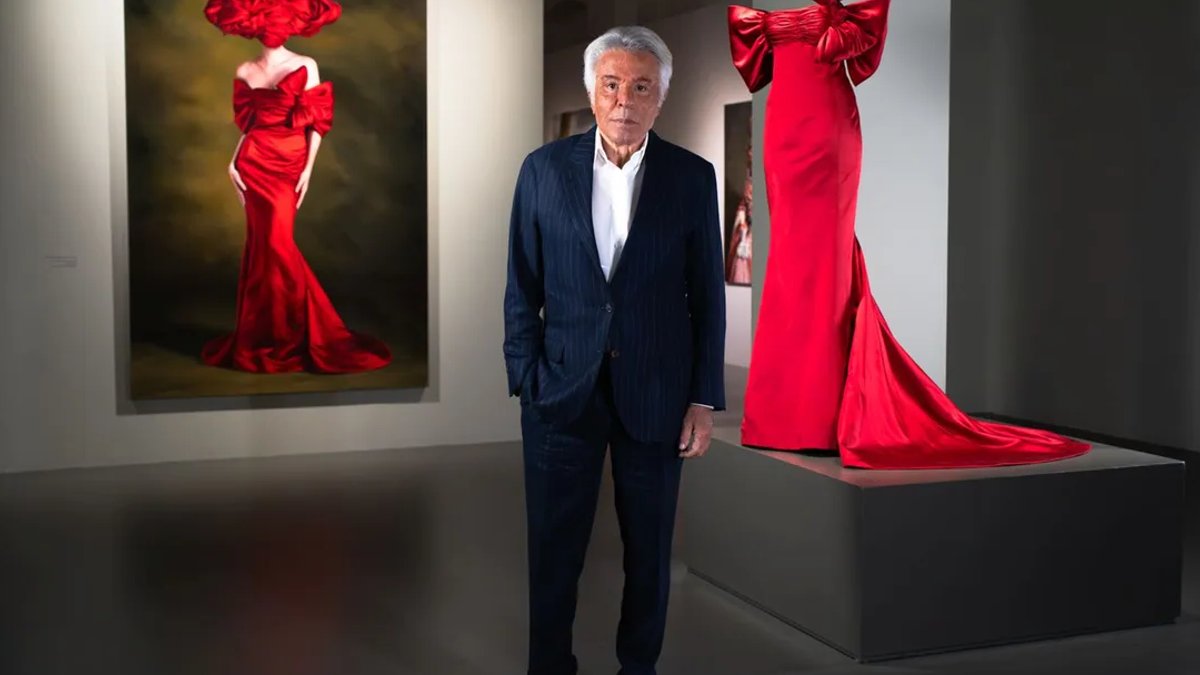
Giancarlo Giammetti argues that fashion and art must coexist, particularly in today’s cultural environment. The Fondazione Valentino Garavani e Giancarlo Giammetti demonstrates this principle through its latest exhibition at PM23 in Rome’s Piazza Mignanelli, which has attracted over 200,000 visitors in under 18 months—a figure far beyond projections for a space not originally conceived as a museum. The third installment, titled Aura, displays 34 haute couture pieces from Valentino’s archives alongside 26 paintings by Polish artist Ewa Juszkiewicz, including a newly created portrait of Valentino based on his 2007–08 red gown.
The exhibition deliberately avoids treating Valentino’s work as a standalone celebration. Instead, it integrates his designs into a broader artistic conversation. Giammetti, who co-founded the foundation with Valentino, states the intention was never to construct a shrine. “Our aim was to bring fashion closer to art,” he explains. “Many visitors initially came for the clothing, but they remained because of the experience of viewing the pieces through an artist’s perspective.”
This method extends beyond Rome. The foundation’s first major international presentation, Venus by Portuguese artist Joana Vasconcelos, has opened at Maat in Lisbon, potentially setting the stage for a worldwide tour. The initiative reflects a broader trend: Italy lacks a national fashion museum, leaving private efforts like this one to fill the void. A proposed Museo Valentino in Rome, announced in 2007 by then-mayor Walter Veltroni, was never completed. Now, Giammetti and Valentino’s legacy are taking on this role independently.
Read Also: Fashion Pioneer Beppe Angiolini, Sugar Founder, Dies at 73
Italy’s absence of a dedicated fashion museum contrasts with established institutions like Palais Galliera in Paris or the Victoria & Albert Museum in London. Giammetti acknowledges the need but stresses the importance of avoiding monotony. “Fashion captivates audiences,” he observes. “If a museum can establish that connection, pairing Valentino’s creations with contemporary artists, it becomes more than a repository; it functions as a bridge.” Early visitor data supports this approach: 80% of attendees came for Valentino, yet many stayed to engage with the art.
The foundation’s activities go beyond exhibitions. For 20 years, it has provided support to families in difficulty. Recently, it has shifted focus to assisting seniors in mastering digital tools, an area frequently overlooked in broader discussions about technology access. “We assist children, but older adults face similar challenges,” Giammetti notes. “The ability to book medical appointments online should not be limited by age.”
The foundation’s exhibitions serve as a tribute to Valentino’s enduring influence, demonstrating how fashion and art can flourish together without relying on formal approval.


